
Lutzanetix CEO Simon Ndukwana believes that industrial transformation begins with equipping people to turn technological opportunity into economic progress.
For Simon Ndukwana the
connection between finance, technology and skills development became tangible during a factory
floor visit in China. Accompanying a group of 50 South African learners undertaking workplace experience, Ndukwana encountered a robot-
driven automotive assembly operation producing close to 1 000 vehicles a
day. The production supervisor was 26 and the workforce averaged just 23.
The experience challenged Ndukwana’s assumptions about what young people could achieve with the right exposure. Ndukwana reveals that 39 of those learners secured placements with BMW and became part
of the team producing their X3 model. For
the chartered accountant and former chief financial officer, it demonstrated how training could connect South African talent with advanced manufacturing.
Today that conviction underpins Lutzanetix’s combination of technology implementation, consulting and skills devel-opment. Drawing on almost 15 years in the skills development field, Ndukwana regards technological capability as integral to profes-sional and industrial progress.
“You cannot do skills development without talking about technology,” he stresses.
Preparing people for industry
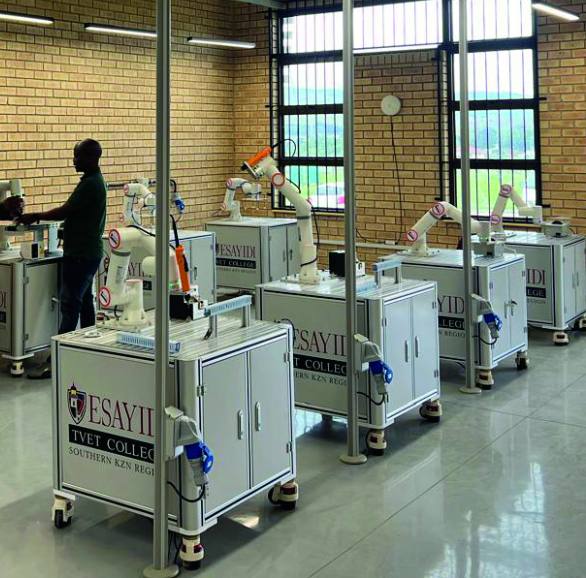
Lutzanetix works with technical and vocational education and training (TVET) colleges to introduce technological capabilities to the future workforce, with
the company currently engaging with 12 colleges along with installations commissioned at four of these colleges with the aim of bringing industrial prototypes into learning environments. The company’s training offering encompasses artificial intelligence, robotics, software engineering, coding and programming.
Ndukwana’s mission is to prepare learners for future production requirements, such
as knowing how to programme a robot alongside understanding how to maintain production systems or operate a 3D printer. He is adamant that technology investment, workforce preparation and mentorship must reinforce one another.
“Firstly, it’s inevitable. We need technology to produce technology which has the poten-tial to go into mass production. We need to automate our production processes because the demand is high, so we need to really pace up with the supply in terms of goods and services,” says Ndukwana.
“We need a labour force that is not uncom-fortable about working with technology
but that, rather, is ready for technology and skilled enough to be operating within that ever-advancing environment.”
Ndukwana believes it is essential that this preparation should precede industrial
demand. He sees particular relevance in rail manufacturing where many technologies introduced through college partnerships also have production working applications.
“The opportunity is there so we need to prepare our people, but it’s important to remember that this preparation needs to happen at least five years in advance. We
need our people to be prepared with the
right skills so that we are ready when the technology arrives.”
Opportunity through change
Ndukwana views any concerns about automation through the lens of operational readiness. His position is that businesses, education providers and government should identify emerging requirements, secure rel-evant expertise and then implement training while these technological opportunities are
still developing.
“We must have a plan that will enable us to prepare for these changes and advancements and we need to develop strategies to antici-pate future change as well as being able to adapt to current changes,” adds Ndukwana, who believes that expanding production can create enormous opportunities across dif-ferent sectors, provided skills keep pace. The enormous market for advanced machinery
and technology across Africa offers incred-
ible potential for manufacturers capable of meeting continental demand. South Africa,
he stresses, already possesses industrial capabilities that deserve greater recognition and development.
“The challenge we have in both the
public and private sectors is that we are over planning at a stage where we should be implementing,” he says.
That urgency extends to South Africa’s con-tinental role, as Ndukwana sees other African countries advancing rapidly while South
Africa retains valuable vocational education structures. Engagements with African coun-terparts have reinforced his belief that the country’s TVET experience can inform wider skills development.
Connecting existing strengths
“Not all is lost. We are still not yet late, but we need to pace up around it. The good news is that South Africa has excellent structures and entities,” says Ndukwana, who believes that a key component of building an innovation ecosystem is the ability to connect the existing pockets of excellence. Research, university expertise, public and private vocational insti-tutions as well as industrial demand all need stronger platforms for collaboration.
With that in mind the Henley Business
School graduate identifies the Technology Innovation Agency as a potential partner
in consolidating innovation and translating research into practical training. Symposia
and skills competitions could help institutions exchange experience.
Private vocational providers also belong
in this effort. Ndukwana believes that their capacity to implement and expand pro-grammes should form part of the broader educational response with the objective of turning individual successes into capabilities that more institutions can adopt.
Growing beyond small business
The same developmental ambition informs Ndukwana’s work with SMMEs and his
finance background has helped to shape an approach that treats enterprise development as a progression from an initial idea through to growing customer demand and, finally, to becoming an organisation supported by effec-tive systems.
“SMMEs are the crux of where all big com-panies have come from,” he smiles, adding that training should therefore equip entrepreneurs to grow beyond survival. “You have to build systems and processes within those SMMEs to ensure their capacity to be able to handle some of those greater responsibilities from their clients.”
Ndukwana is passionate about delivering the message that entrepreneurs must recog-nise that their current size does not define
their eventual reach.
“The status of being an SMME is not meant to be the permanent status quo. We train you so that you understand your potential and to create a vision for what change you want to make.”
He recounts mentoring a company whose revenue grew from approximately R2 million to nearly R400 million over a decade. For Ndukwana, challenging an entrepreneur’s assumptions about their potential sits along-side actually building the structures needed to manage their expansion.
“There’s a moment when your company grows that you realise that this thing is now growing beyond you,” he laughs.
Turning partnership into progress
Having worked across the private finance, government and entrepreneurship sectors, Ndukwana is convinced that collaboration
also requires attention to administrative obstacles. He recalls an occasion when a shipment of imported equipment for college projects was stuck at a port for two months, with the added frustration of attracting pen-alties of around R70 000. Such experiences, he argues, can discourage companies from investing in technology.
Calls to develop enterprises loses force
when procedures make trading and growth more difficult, which is why support must include clearer requirements and simpler administration.
He remains frustrated by the gap bet-ween public commitments to reduce red tape and the obstacles encountered by businesses.
Measuring the impact
Looking ahead five years Ndukwana has cast a number of ambitious aims in con-crete ambitions: his goal is for Lutzanetix to have trained at least 200 learners through to specialist capability in robotics and automation, but also to have equipped and empowered 50 lecturers or facilitators with the capacity to be able to pass on techno-logical knowledge to successive cohorts of students.
“If I train 50 lecturers then I know I’ve helped to train 1000 students, because many learners are going to go through each lec-turer’s hands,” he adds.
The importance of exposure
Ndukwana’s leadership philosophy combines continuous learning, practical application and strengthening relationships, and he believes strongly that each individual is a product of what they know combined with who they know and who they relate with and network with.
“As a leader you need to be challenging
yourself in terms of knowledge and in terms
of your exposure to the new ideas out there in
your industry as well as the greater economy,” says Ndukwana.
“Start applying some of that knowledge
and make it practical and implementable, because I think we are living in a world where there’s too much information and theory. And partnerships are essential to give that knowl-edge wider reach.”
For Ndukwana the lasting measure of leadership is the capability it helps others to develop within themselves.
“The partners that you work with will determine where you’re going to go,” con-cludes Ndukwana.