
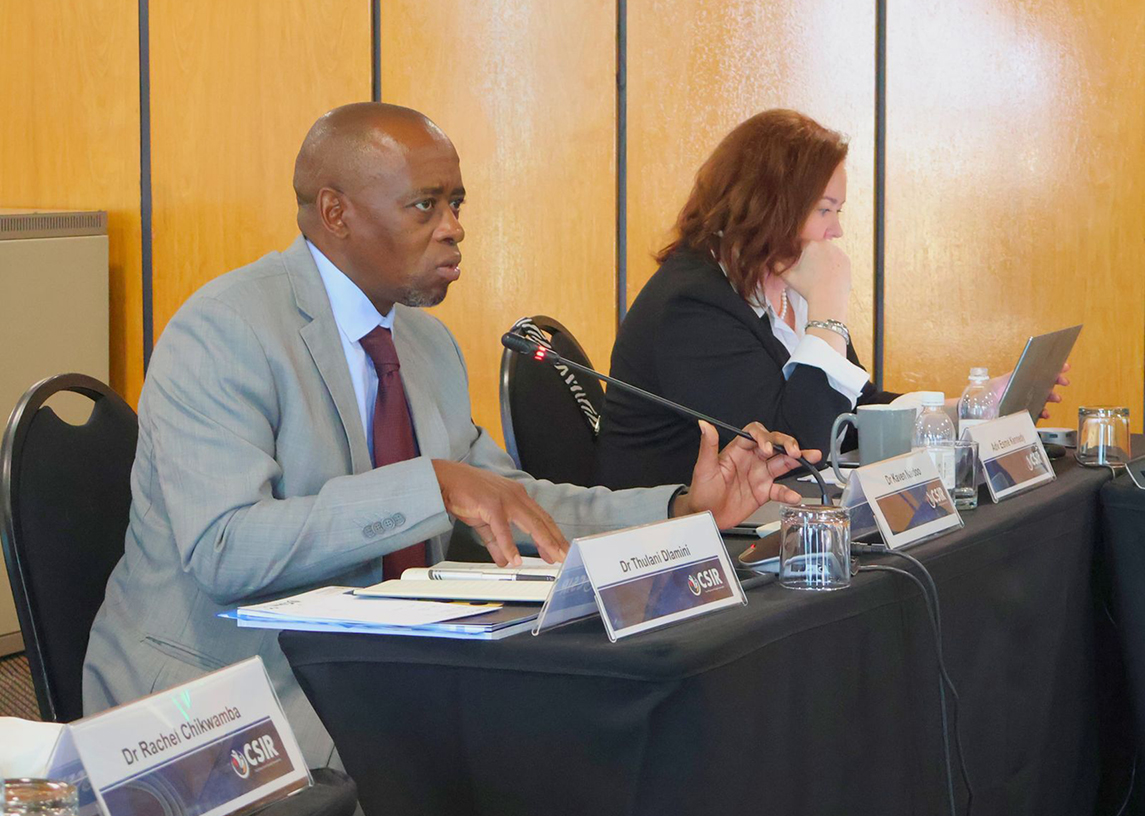
South Africa’s scientific and industrial community gathered at the CSIR for a high-level roundtable reflecting on a milestone year in the organisation’s history.
The event took place shortly after the CSIR released its 2024/25 Annual Report, a document that demonstrates strong financial results, growing national influence and real progress in using science and technology to support development.
For many years, the CSIR has been known as one of Africa’s leading centres for research, innovation and advanced technology. But this roundtable demonstrated that the institution is not only producing knowledge, it is shaping new industries, improving public services and opening paths for economic transformation. The gathering brought together researchers, government officials, private-sector leaders and technology experts, all united by a shared belief that science can solve everyday challenges and unlock national growth.
Eighty Years of Scientific Excellence
There was a strong reminder that this is a particularly meaningful period for the CSIR. In 2025, the organisation celebrates 80 years since its establishment by an Act of Parliament in 1945. For eight decades, the CSIR has developed technologies, technical solutions and research that have improved the quality of life for South Africans, strengthened local industries and supported government in delivering services.
The roundtable highlighted that the CSIR is not only proud of its past, but also actively redesigning its future. Its work now spans modern technologies such as information security, robotics, artificial intelligence, advanced materials, biomanufacturing, environmental science and renewable energy. These fields are crucial for developing a competitive industrial economy and preparing the country for the demands of a rapidly changing world.
Strong Financial Results in a Tough Economy
A major theme at the session was sustainability. The CSIR’s Annual Report shows that even during a challenging economic environment, the organisation has remained financially strong and efficient. Total operating income grew by 11%, moving from R3.17 billion in the 2023/24 financial year to R3.54 billion in 2024/25. Income from the private sector increased by 7%, and international income by 10% — clear evidence that the organisation is trusted both locally and globally.
The CSIR also achieved or exceeded 29 out of its 31 key performance targets, giving it a 94% success rate. These indicators measure the organisation’s delivery on innovation, research outputs, partnerships and economic impact.
One of the most impressive outcomes was the financial turnaround. A loss of R67.6 million had been projected for the year, but the CSIR was able to report a net profit of R40.62 million instead. For a public research institution operating in a tightening budget environment, this represents disciplined leadership, efficient spending and smart resource management.
Backing these results is a clean audit opinion from the Auditor-General of South Africa, the 15th consecutive year. Consistent clean audits reassure partners that the CSIR’s financial controls, governance systems and compliance structures remain solid, transparent and trustworthy. For investors and collaborators, this gives confidence that resources are well managed and directed toward meaningful innovation.
Growing Real-World Impact
Throughout the roundtable, speakers emphasised the difference between research for the sake of research, and research that touches people’s lives. The CSIR has been pushing strongly toward the second by ensuring that its scientific work reaches communities, businesses and public institutions.
This commitment is most visible in how the organisation is commercialising technology. Through its commercialisation unit, CSIR C³, the organisation is fast-tracking inventions into the marketplace. In the reporting year, 12 new licence agreements were signed with industry partners, allowing business to adopt and produce technologies developed in CSIR laboratories.
Several products, including MycoSure, Stratafy and Herbathone™ — are now much closer to being fully available in the market because of these agreements. These are more than research ideas; they represent future jobs, new industries, new export potential and solutions that can give South African companies a competitive edge.
The organisation also reported an 11% increase in localised technologies and a 17% rise in joint technology development agreements with industry. This growth shows that private companies see the CSIR as a trusted partner in developing solutions that meet commercial needs. When science and business work together, products move faster from the lab into factories, hospitals, farms, and public infrastructure.
Supporting the Growth of Small Businesses
The roundtable also highlighted something important: innovation must reach entrepreneurs. Through access to advanced laboratories, technical expertise and specialist equipment, the CSIR supported more small, medium and micro enterprises across sectors including aerospace, biomanufacturing, additive manufacturing and infrastructure development.
For many technology-based SMMEs, this kind of support is impossible to access independently, because equipment and research facilities are costly. By opening its resources, the CSIR helps smaller businesses to build prototypes, test products, grow into new markets and create jobs. A 3% increase in SMMEs supported may sound small on paper, but in practice, it represents new opportunities for companies that would otherwise struggle to compete.
A Trusted Partner to Government and State-Owned Entities
A powerful message from the roundtable was that the CSIR is strengthening the state’s ability to improve services and drive innovation. Projects implemented for government and SOEs increased by 22% at the highest level since 2019. These partnerships are not theoretical. They support real issues affecting South Africans.
Some of the highlighted projects included:
Predictive models to assist with planning for national and provincial elections
Environmental impact assessments supporting the green hydrogen economy
Frameworks to transform taxi ranks into modern economic hubs with services, safety and business opportunities
These initiatives show that science can directly improve public policy, infrastructure and national planning. They also demonstrate that innovation can help modernise informal and public spaces, making them more productive and safer.
People at the Heart of Innovation
Behind each successful project is a community of scientists, technologists, engineers and researchers. The CSIR now employs 2 298 people, and 70% of them are science and engineering professionals. The organisation places strong focus on developing and transforming its human capital by ensuring that scientific excellence is inclusive and reflective of South Africa’s demographics.
The report shows that 73% of science, engineering and technology staff are black South Africans, and 40% are women. Talent development programmes, such as the Accelerated Researcher Development Programme, continue to build a pipeline of future scientific leaders through training, mentorship and advanced research opportunities.
The number of chief researchers increased by 31% demonstrating growth in senior scientific expertise. In addition, publication outputs increased by 27%, signalling high-quality scientific work at international research standards.
A Message of Leadership and Responsibility
CSIR Chief Executive Officer, Dr Thulani Dlamini, used the roundtable platform to highlight that the organisation’s mission goes beyond research excellence. He reaffirmed the CSIR’s commitment to addressing South Africa’s deepest development challenges such as poverty, unemployment and inequality. He noted that the organisation’s partnership with government, industry and universities is stronger than ever, with the highest level of public-sector collaboration recorded since 2019.
Dr Dlamini also expressed appreciation for the commitment of CSIR employees, the Board and the Minister of Science, Technology and Innovation, Dr Blade Nzimande. His message was clear: innovation must remain people-centred, ethical and impactful.
A Future-Focused Vision
While the roundtable celebrated achievements, it also recognised that serious challenges persist. Declining public funding, rising operational costs and global instability affect South Africa’s scientific ecosystem. For the CSIR, continued innovation depends on sustainable investment and strong partnerships.
Yet, the organisation’s performance shows that progress is possible, even in difficult conditions. By translating research into industry, supporting SMMEs, building skills and strengthening public-sector solutions, the CSIR is demonstrating what science-driven development looks like in practice.
A Clear Path Forward
At the close of the roundtable, the message was hopeful. South Africa has the talent and capacity to build advanced industries, modern infrastructure and new technologies. The CSIR’s journey over 80 years proves this. The next chapter will be about scaling impact, also turning more ideas into products, supporting more businesses, and ensuring that innovation touches every part of society.
For partners from both business and government, the roundtable was more than a discussion, it was an invitation. It reinforced that South Africa’s future will depend on research, technology, collaboration and a shared commitment to progress.
With a strong financial year behind it, a pipeline of new technologies, and expanding partnerships at home and abroad, the CSIR is not only maintaining its legacy and it is shaping the nation’s innovation landscape for decades to come.