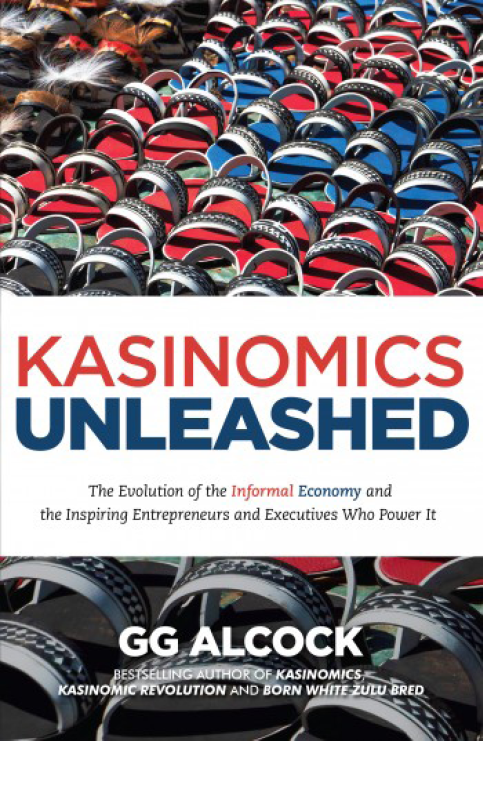
BBQ is delighted to publish an excerpt from GG Alcock’s new book, ‘KasiNomics Unleashed’.
In James Dyson’s book, ‘Invention: A Life of Learning through Failure’, he says of entrepreneurs: ‘The true French meaning (of entrepreneurs) defines a combination of builder and architect.’ I like that idea of builder and architect and it applies so well to kasipreneurs—the multitudes of informal business people out there. We should add resilient and resourceful, building businesses with no resources, surviving the shocks of macro economies and pandemics. The kasipreneurs in my definition are independent business innovators, hustlers and gig workers.
Mirriam Tshamane wakes up just before 3.00 am five days a week and heads to Baragwanath taxi rank in Soweto in her little LDV. Bara, as it’s called, is adjacent to Baragwanath Hospital, the largest hospital in the Southern Hemisphere, built for wounded soldiers in the Africa campaign of the Second World War. More than 2 000 taxis operate out of Bara taxi rank, with more than 10 000 000 commuters passing through in a month—travelling to the hospital, to work in the city, coming from various parts of Soweto. It’s a frenetic yet organised chaos of taxis, commuters, mobile hawkers and table-top traders, where anything can be bought; herbal traditional medicine like imphepu to summon the ancestors for good luck, delicious fresh piles of fruit and vegetables collected from farm gates in Northern and Eastern South Africa, or from the giant Joburg Fresh Produce market by a host of bakkie brigade delivery vehicles, as well as power banks and solar chargers, cosmetics, phone repair, snacks and airtime, or tables laden with large, plucked whole ‘hardbody’ chicken, sloppy green grey mogodu or tripe, delicious grilled chicken sosaties, boerewors or blade steak, seven colours amaplati plates of stews, vegetables and salads and at 4.00 am delicious deep-fried amagwinya, fat cakes, not because they make you fat, although undoubtedly they do, but originally fried in fat. Amagwinya means mouth waterer from the Zulu word Gwinyamathe, swallow your saliva. And boy are they mouth-wateringly delicious. In winter, when they are most popular, grabbing a hot gwinya, pulling it open and filling it with a Parmalat Cheese Slice and polony is simply delicious.
Mirriam starts frying vetkoek in her three-by-three metre cubicle at about 4.00 am when Bara starts bustling. She prepares four bags of 12 kg Supreme Flour every day, making and selling about 1 200 to 1 500 vetkoek for R1.50 each, at a profit of about R800 a day. At 10.00 am all her prepared dough for vetkoek has been used and she then prepares her horse mackerel to deep fry in a batter. When I meet her we chat while chewing mouthfuls of the crispy, deep-fried fish wrapped in paper. Mirriam sells between 100 and 200 fish portions a day at R25 to R30 and makes an approximate R500 profit a day on her fish sales. Depending on the time of month—beginning or end of the month, which are usually busier—she can make up to R1 500 gross profit a day. Mirriam pays R200 rent for her little workspace and makes a good living. She has bought a little Nissan van, cash—not that she’d be able to get finance, as her business has no financial records. So, that question I asked earlier, does the fact that no written record exists of her earnings mean that Mirriam is a mirage?
I asked Mirriam where this all started. ‘I used to be a schoolteacher, teaching geography and maths, she tells me. ‘Then in the early 90s I decided to be an entrepreneur, so I went and did a course with Raymond Ackerman, do you know who he is?’ She looks questioningly at me. I nod, smiling, ‘Yes I have heard of him.’ Raymond Ackerman was the founder of the Pick n Pay supermarket chain. ‘After I finished the course, Raymond Ackerman gave me R250 and so I came here and started this business from that money, and the lessons he taught helped make this business successful.’ She waves expansively around that small space which is such big business for her.
What a difference we can make in small ways, I think to myself, knowing instinctively that Raymond Ackerman would be immensely proud of Mirriam. I ask her why she wanted to stop being a teacher. ‘Money,’ she says. Mirriam is often eloquent and talkative, speaking at length. But at other times she answers abruptly—usually, I think, when she finds my questions stupid and loses patience. ‘Money?’ I prompt. She looks at me like I am an idiot while reaching into her apron pocket, pulling out a roll of rand notes. ‘Yes, this thing!’ I have to laugh, ‘Yes, okay, that thing, but teachers also get that thing.’ She answers quickly, ‘Only at month end and not enough. You see, I make good money every day and every day I can take R200, sometimes more, from my earnings in this pocket,’ patting her apron pocket with the notes, ‘and I put it in the other pocket and save it. Work that out, I can save more than R50 000 a year. Teachers can’t do that.’
Mirriam has been running the same business for 30 years, perched on a stool, a gas deep fryer for her fish on one side of her, and on the other side a fridge and an electric deep fryer for the vetkoek.
Although Mirriam’s business grows incrementally, she does not scale. And while she earns a good living, she works hard, day by day. She sometimes has a casual employee filling in from time to time, but she is never able to employ staff, start new branches, or grow beyond a certain point.
I ask Mirriam about scaling her business, or even starting other branches and maybe employing staff. She waves her hands around, she is happy with this, she earns a good living, she has a car, she has a house, she doesn’t have the hassle of managing staff ‘who steal, especially the South Africans!’ and she must also then be a manager. She wants to cook tasty food, ‘You can see my customers, they love my food, I want to make them happy,’ she elaborates. BUT what if she wanted to scale, to grow a Mirriam’s Fish & Vetkoek Empire?
Let me tell you about Nomgqibelo’s Delicious Treats in a rented corrugated iron shack backroom. As you walk in there is a sign on tattered cardboard and a price list on the corrugated iron wall.
As you enter and your eyes adjust to the darkness, and you stoop so as not to bump your head on the low roof, you see a sort of room divider—a neatly piled five-foot high stack of Supreme 12.5 kg flour. On the other side of the ‘room divider’ is a double bed with a pretty floral bedspread, colourful pillows and a solar lamp hanging from wire attached to the ceiling.
The walls of the shack are ‘oak panelled’ (recovered wood to make the corrugated iron shack warm and cosy inside). Turning to your right, Nqobile Shongwe, known as Nomgqibelo, is squeezed into a tiny kitchen, a small TV on a kitchen table, a microwave alongside. Further over, a large—slightly larger than a domestic oven—has rows of scones baking inside, the delicious smell making your mouth water.
A plastic table stands next to a kitchen cupboard with baking bowls, crockery and cutlery. On the table are rows and rows of biscuits and scones—the queens aren’t ready yet. The biscuits cooling off in neat, stacked piles, the scones in bags of fours and neatly packed are on and under the table—the ones under the table packed in 20 litre and 10 litre white plastic buckets.
Nomgqibelo’s business partner, Lulamile Sishuba, hovers around protectively. He’s the salesman going out to deliver the buckets to the street hawkers selling at street corners, or the table-top traders selling in ranks, school yards and residential streets. He gets the orders on WhatsApp along with a pin location, ipini, sometimes even a live mobile location and trots down the road, catching them on the live location, and getting his cash and handing over the bucket, while the mobile seller continues his business street by street, house to house, shouting loudly amaKeke Biskidi Skoni.
They employ two staff who sell on the street in front of Jabulani Mall and Bheki Mlangeni Hospital across from the mall. Their biggest sales volumes are orders from caterers for weddings, funerals, unveiling ceremonies and other cultural events, when there are orders of the large 20L buckets of queens, biscuits or scones. Walk in sales are another large part of their daily turnover. They have never advertised, but the word has spread over the years and they sell everything they bake—often running out of stock. When I chat to them in January 2025, they tell me they only closed on the 23rd of December, fulfilling orders.
Nomgqibelo was originally a domestic worker for a white family in the suburbs, and she only baked and sold on weekends. She proudly tells me how she started making more money from her weekend bakery sales than her monthly domestic servant salary. ‘I realised that I could do very well if I baked full-time, so I gave them notice. They were sad to see me go, but I had to see what I could do in the baking business.’
When the orders exceeded her capacity, she hired Lulamile, who later became a partner in the business. Lulamile handles sales and does the heavy work, including taking a taxi to the wholesaler in Kliptown and hiring a bakkie to bring back the thirty bags of 12.5 kg Supreme Flour and the five bags of 12.5 kg Selati sugar they use per week—spending over R7 000 a week. Demand still overtakes their capacity, so I ask them why they can’t fulfil demand. ‘It’s the space,’ he says. ‘We can’t fit another oven.’
‘So why don’t you move to a bigger space, or even buy a house and move your business there?’ She scowls at me. Clearly, I know nothing about business! ‘It would take too long to get new customers. It took us years to build our customer base,’ she explains. Lulamile picks up from her, explaining that they rent this shack. He lives there and she rents just down the road. Neither of them will stay here forever; she hails from Volksrust in Mpumalanga where she has built a ‘big house’ and he is Xhosa—I can tell from his accent—from Komani in the Eastern Cape where he has also built a house.
‘No, not my own, a house on my father’s property.’ They each plan to return to these rural homes someday. For now, they make good money, they sell everything they make, they trust each other, and they have good loyal customers and two excellent salespeople.
‘Have you thought of employing more salespeople?’ I still try to understand the limits to scaling. Lulamile frowns, this mlungu just does not get it. ‘Then we would need to bake more. We just bake enough to supply them, so no!’ I have come full circle, they need more space to bake more, if they bake more they need more customers and they may lose some of their regular walk-in customers if they move, and if they employed more staff they would need to bake more, but for that they need more space!
‘And will you sell this business?’ I ask Nomgqibelo. I mean it must be worth a fair deal. ‘The youngster will take it over,’ Nomgqibelo says. Lulamile nods, they see no commercial value in selling it, rather it is passed on to partners or family.
It’s a shame that businesses like this don’t see the benefit of growing real value before thinking about selling. To them it’s an income generating occupation, not a business with resale value. It’s frustrating that a simple shift in how we define and value a business could transform these so-called ‘informal’ businesses, yet it remains overlooked.
GG Alcock is the author of ‘KasiNomics Unleashed’