

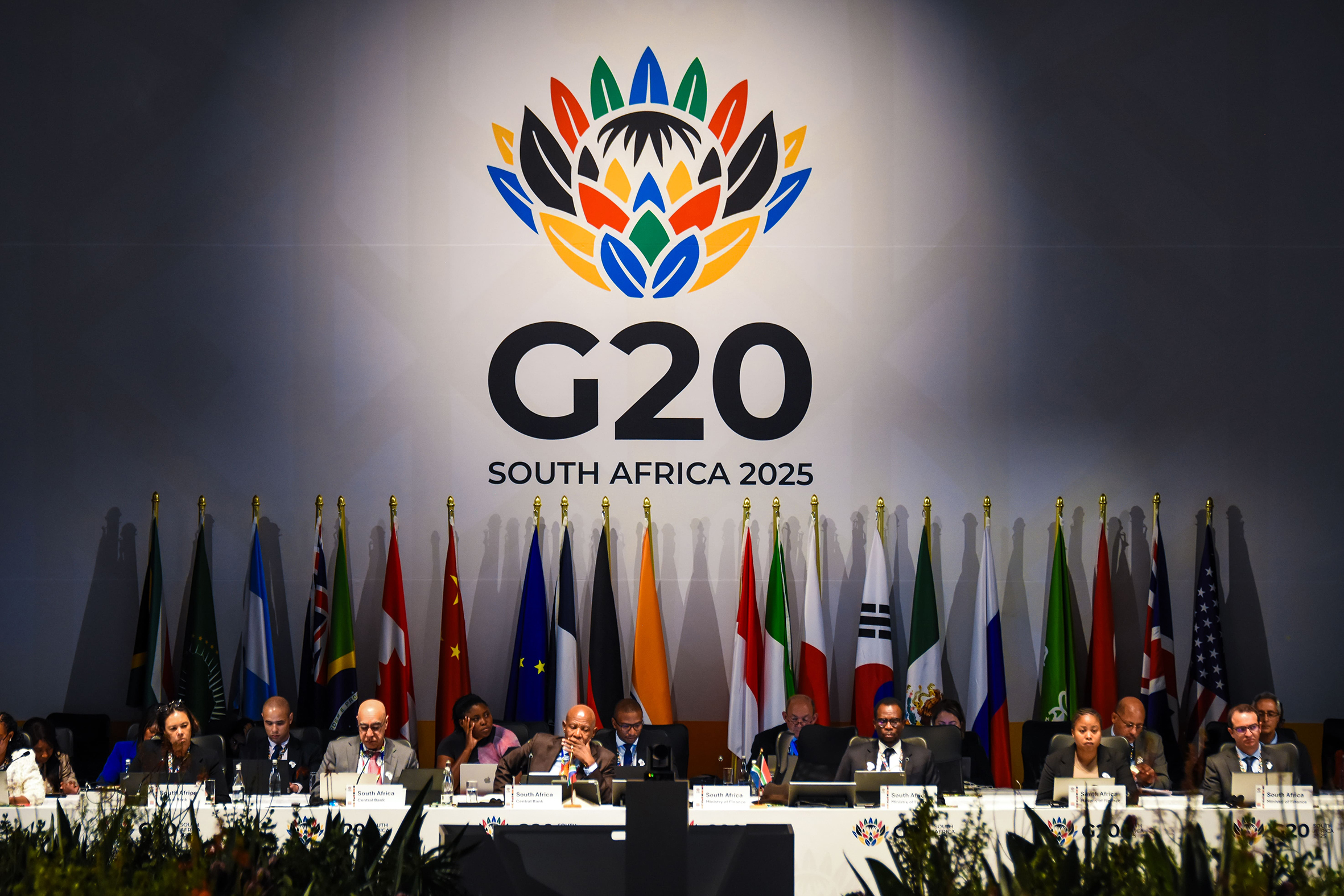
The dust has not yet settled on South Africa’s Africa’s historic G20 year as Leadership summit concluded on Sunday with a range of views on its successes and shortcomings in a world rife with multiple geopolitical storms, Trumpism redefining partnerships and solidarities.
A brief scorecard unpacks multiple contradictions and shifting sands amidst stagnation
IFI reform and African Debt crisis and Cost of Capital stagnation
Global finance is the DNA of the G20 and took place in the year when African faces is greatest debt crisis. South Africa’s ‘downgrading’ (excuse the pun) of the all-important Cost of Capital commission can be seen a capitulation to creditor nations and credit agencies. For its part, only SA was rewarded with an ‘S&P ratings upgrade’, while no African nation in debt distress got any rating concession. Solidarity? African Agency? Clearly not.
For sheer scale of global financial inequality, it is sobering to note that with regards to IMF bailouts, one country – fellow G20 Argentina received $22 Billion bailout – more than the entire African continent. In terms of World Bank support, Ukraine has received more development aid than the entire Global South. Ironically, they are also the most neo liberal economies needing global bailouts. The G20 communique hardly addressed these structural inequalities in Global finance and even the UN Global tax treaty work took a back seat.
Climate change – COP 30 Belen leads with concentre outcome
While the South Africa’s G20 themes were commendable and sustainability, solidarity and climate change featured in the working groups, recommendations were lukewarm and non-committal in terms of real resource allocation.
By contrast Brasils COP 30 Belen stewardship proved an example of a solid South development agenda with the Mutirão Decision (a term used by the Presidency to signify a collective, community-driven effort in Brazilian Portuguese) with clear commitments has Climate Funding mechanisms, the incorporation of indigenous communities in mining areas ,a clear commitment to combat climate disinformation and the support Forever Forest facility etc.
Here Brasil and China have emerged as the true champions of multilateralism and sustainability in the midst the significant powers and petro states push back, Even the EU has backtracked in its COP30 emissions agenda, as EU nations scour the globe and Africa for energy, oil, gas, hydrogen and resource extraction.
In terms of global powers, China has been the de facto global multilateral champion; it has agreed to all its COP30 commitments and NDCs as well as voluntarily given up its Most Favoured nations MFN status WTO in a year of economic nationalism of US and EU (AGOA, CBAM,). China has also provided all African Nations with duty free access for all goods
Information integrity and social media regulation has been a real challenge in 2025. Despite the themes of information integrity being a core of the UN Global Digital Compact GDC the G20 failed to include just two words on the final 30-page statement, a major gap in the era of disinformation and climate denialism. Fortunately, Brasils Belen declaration managed to save the day with commitment to combat climate disinformation.
AUs Peace & Security falters, the non-silencing of the Guns and human rights contradictions galore at the G20
The clear and present dangers for Africa are the multiple wars and civil wars on the African continent, many linked to resource extraction zones in DRC, Sudan, Mozambique, Sahel etc.
In this context red carpet invitation to the UAE was the sore thumb symbol of the G20s human rights agenda. The invitation to the UAE as special guest is a diabolical contradiction given its nefarious role funding the rogue RSF forces that are currently engaging in genocide in the Sudan – a violation all UN and AU and Geneva conventions. Yet the special invite stands a sore thumb – a symbol of South Africa’s deep contradictions in its supposed human rights centred foreign policy. Here one can see the ‘Investment agenda’ trumping South Africa’s G20 human rights agenda. Much explanation is needed by leadership.
For its part, Canada’s Mark Carney, a fellow G20 member and supposed ’global human rights champion’ signed a $ 70 billion investment agreement with the UAE just days after their G20 attendance. This gives credence to the view that the G20 in 2025 was more of an investment forum without sustainability human rights’ (William Shukri, 26 November 2025)
With only a handful of African leaders invited and even those did attend, Nigeria, Kenya and Zimbabwe only sent Vice presidents or lower, officials. Perhaps this signal the unhappiness at the lack of any meaningful outcomes on the African finance agenda?
Does SA deserve a space in the G20 club with its ‘sub imperialism play’
For scholars and social justice activists the G20 has always been as an elite global forum reinforming the major global challenges of inequality and exclusion. The 2025 geopolitical storms continue even as South Africa ends its G20 terms, with President Trump announcing a possibility that South Africa will be ‘disinvited’ to the US G20 in 2026.
What should be done? Given that South Africa had a historical moment o firmly put the African agenda and secure real outcomes such as debt relief but failed.
Instead of pushing a bold Africa it we were reduced to playing the role of a broker and pawn’’ for powerful G7 (G6) and getting involved in a complex geopolitical spat between EU and US. The main winners of G20 were the EU which well organised and promotion of its core themes and managed to secure most invitation by any bloc, and then segweyed much of it attended the AU- EU Summit in Angola the following days with a coherent investment agenda.
South Africa inadvertently played role of the ‘conveyor belt’ in the re-entry of old colonial EU back into African continent. Here its role as a ‘sub imperialist state’ is merging, very similar to India in Asia. By acting as ‘broker and dealmaker’ and opening up of continent for further extractive exploitation of the African Peoples.
President Trump is somewhat correct when he questions South Africa’s inclusion in the G20. A non-seat at the G20 for Africa in 2026 may be a blessing in disguise as the G20 has not delivered on the African agenda. Another spat with the US in 2026 will be diplomatically exhausting and expensive. Perhaps in the spirit of Ubuntu and solidarity and acknowledging its inability to secure concrete outcomes for Africa, South Africa should ‘mature up’ and cede its G20 seat to a fellow African nation in 2026.
Now that would be real solidarity and ubuntu in action.
There must be an alternative to sub-imperialism!
