A short yet poignant story by Dr Kaizer Nyatsumba.
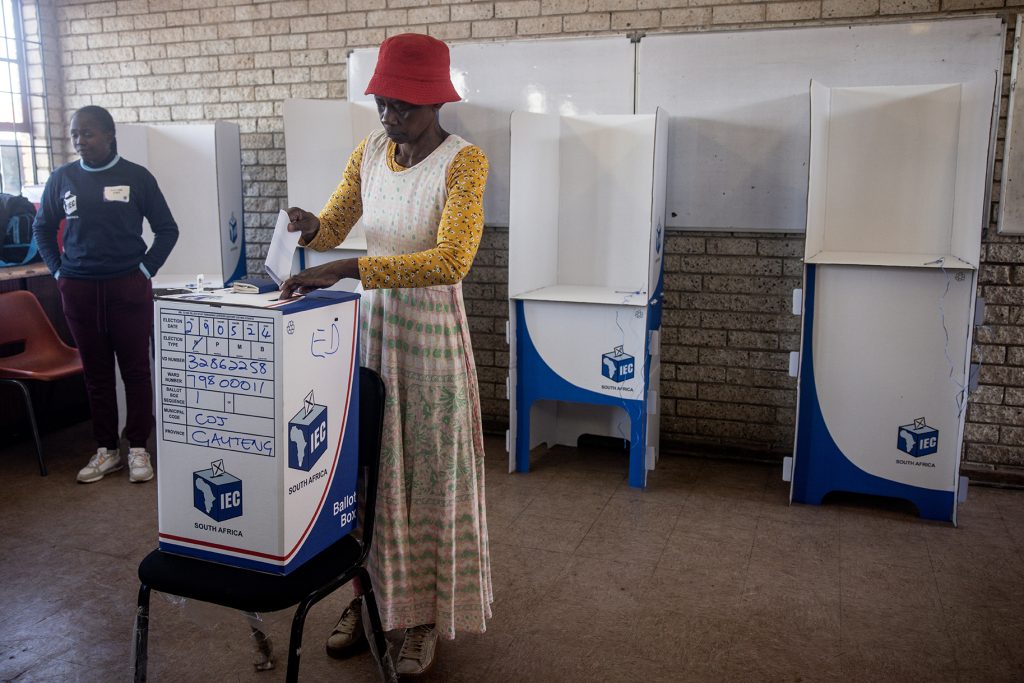
The first meeting of the Cabinet after South Africa’s eighth general elections in 2029 was not easy. Although the elections were over, mutual suspicion among the Ministers from the different parties hung in the air in that Cabinet Room. During what was a robust election campaign, the different parties had all said terrible things about one another. While they were now charged with the responsibility of co-governing the country, the things that they had said about each other were still fresh in their respective minds, much like the aftertaste of lemon after one had eaten that fruit.
President Caiphus Nkosi understood the importance of the colossal task ahead of him if he was to succeed in his efforts to forge a united government. The National Assembly had had to vote multiple times before he was elected, and even then he had won by the narrowest of margins. At fourth attempt, he had managed to get 201 votes, with his most serious contender, Democratic South Africa’s Richard Smith, getting a creditable 188 votes. The remaining eleven votes had gone to Ntombi Kolisi of The Land Party and Tarum Bhamjee of the Minorities Party.
In negotiations for the coalition government, Democratic South Africa had insisted that its leader, Richard Smith, should be appointed Deputy President of the country. Although some in the Congress Movement were implacably opposed to the idea, there was nothing that they could do. To form a government, the latter needed the second-largest Democratic South Africa in that coalition. Therefore, for the first time since the dawn of democracy, the Deputy President came from a party other than the one to which the president belonged.
There was a sense of fairness in that arrangement. After all, Democratic South Africa – a party which was formed in the run-up to the 2024 elections – had obtained 30% of the vote, with The Land Party obtaining 6% and the Minorities Party getting 4% of the vote.
Mindful of the fact that it was thanks to the hard work of his party’s leaders that had seen other smaller parties in the National Assembly eventually supporting his candidature, President Nkosi had rewarded those parties with seats in his Cabinet to shore up his party’s number. On its own, his Congress Movement had obtained a paltry 33 percent of the vote in the national elections and had lost the elections in eight of the country’s nine provinces. It had barely hung on in the Eastern Cape, where it had obtained 49,9% of the vote. It would need the help of just one small party to form a government.
He remembered the bitter recriminations that had taken place within his party after the Independent Electoral Commission had released the results. The first meeting of his organisation’s National Executive Committee (NEC) had been absolutely chaotic. Some of his comrades had laid the blame at his door for the organisation’s terrible performance. They had even suggested that a different candidate should be put forward for the National Assembly elections to be the country’s president.
Nkosi was deeply disappointed by that turn of events. How, he wondered, could he be said to be responsible for the shameful electoral outcome when he had worked tirelessly to campaign for victory in the elections? He fought back vigorously. He reminded his comrades that the organisation had been on a downward trajectory for more than two decades. After all, it had managed a mere 40% in the previous election, down from a reasonable 57%. Five years earlier, when the Congress Movement lost a whopping 17% of its votes, nobody had blamed his predecessor. With him in charge, the organisation had performed a mere seven percentage points worse than it had done five years earlier, yet his comrades clamoured for his head.
“But how am I responsible for this performance, comrades?” Nkosi had demanded in the NEC meeting. “Have I ever been mired in any scandal? No. That cannot be said about me. It is not my fault that our economy had continued to perform poorly. You know, as well as I do, that we have been targeted by that chap in the White House because he hated our progressive policies. You will remember that when I urged you that we revise some of those policies, you almost ate me alive. That’s how committed you have been to our historical policies.”
Nkosi had hardly finished his statement when one of his comrades from KwaZulu-Natal shot back that the electorate had been confused by the rebranding that he had suggested.
“It was you, Comrade President, who insisted that we should change our name to CM because you claimed that our historical name was associated with corruption. If we had not done that, chances are that we would have held on to our support,” said Muzi Ndlangamandla.
Getting hot under the collar, Caiphus Nkosi had insisted on responding. “Comrade chair, I do beg your indulgence,” he said, addressing the Congress Movement’s National Chairman. “I must respond to Comrade Muzi. Do members of this NEC not remember that every survey that was conducted in the country, including our own surveys, consistently indicated that our people had lost all trust in the African Congress of South Africa? Was it not this NEC that resoundingly accepted my recommendation that we should rebrand to the Congress Movement? You may remember, comrades, the amounts of resources that I mobilised to enable us to embark on a massive marketing campaign to promote the new brand. You will also recall that the surveys that were conducted subsequent to the rebranding showed higher public trust levels in CM than in the ACSA?”
After a long, heated debated, it was eventually agreed that Caiphus Nkosi would continue to be the Congress Movement’s candidate for president in the National Assembly. Since then, much lobbying had taken place, with promises made that leaders of some of the smaller parties who would vote for Nkosi would be appointed Cabinet Ministers, ambassadors or chairpersons of parliamentary committees.
All those thoughts were still fresh in President Nkosi’s mind as he and his Cabinet Ministers gathered, for the first time since their swearing in, in the Boardroom for their first Cabinet meeting. He was still exhausted from the long election campaign and the subsequent struggles that he had found himself in. Very conscious of the fact that the vast majority of the country’s electorate had rejected his organisation, Nkosi knew that he had to ensure that the coalition government remained in place throughout its five-year term. That would require that, unlike his predecessor, he and the Congress Movement learned to govern more collaboratively, ensuring that its policies and decisions were a product of consultation. He knew that all it would take to relieve him of his position was a vote of no-confidence in Parliament, if it were supported by his coalition partners.
President Nkosi called the Cabinet to attention.
“Ladies and gentlemen,” he said, “welcome to the inaugural Cabinet meeting of our eighth administration. Congratulations on your appointment. I look forward to working with all of you.
“After a long and acrimonious election campaign, the people have spoken. Our respective parties got together to form this coalition government. Speaking for myself and the CM component of the Cabinet, I want to assure you that we will work with each one of you to put our country’s interests first. We will be driven not by what is in the CM’s interests, but what is in all our people’s interests. I ask that you all do the same.
“As I have said, the elections are over. Collectively, we are now the government of this Republic. Over the next five years, we must work together to fight crime, to grow our economy, to create jobs and to ensure equality among our compatriots. We must pull together as one …”
“Or perish together as fools,” said Deputy President Smith.
“The Honourable Deputy President is right: we must work together or perish together as fools. In that case, history will judge all of us harshly. As President, I will support all of you, including DP Smith, in the execution of your tasks. DP, I will make sure that I assign meaningful responsibilities to you. Let us make our people proud. Let us make the founding president of our democratic Republic, Madiba, proud of us.
“Believe me, my movement has learned its lessons. You will not encounter any arrogance from our part. We will not attempt to ride roughshod over the Cabinet to take any decision on our own, or with the support of parties that are not members of this Cabinet. As you know, I have ensured that this Cabinet is proportionately constituted to reflect our respective results in the elections.
“At this stage, I will ask DP Smith to say a few words.”
Smith cleared his throat.
“Thank you, Mr President,” he said. “I echo your sentiments. We from DemSA are here for one reason only: to serve our people. Therefore, you will, in me and my colleagues, find ready soldiers to fight by your side, Mr President. We will cooperate fully with the President and all Ministers in this Cabinet, provided that is in the interest of our country. I ask that all of us in this coalition do so.
“However, Mr President, I must also state that we will not only serve all our people, but we will do so with a great deal of passion, enthusiasm and integrity. Integrity is paramount to us. We will not sit quietly when we see any one of us behaving in a manner that shortchanges our people.”
“Hear, hear,” said President Nkosi. “We will not allow any whiff of corruption or scandal in this government. Let me warn all of you now that anybody who may find himself or herself mired in any scandal will be let go, regardless of the party that you belong to.”
As a courtesy, President Nkosi also offered The Land Party’s Ntombi Kolisi and the Minorities Party’s Tarum Bhamjee an opportunity to make preliminary remarks. With the introductory remarks out of the way, the Cabinet then went on to discuss matters on its agenda.
Although the months that followed were difficult for the three parties in the coalition government, they were more so for President Nkosi and his Congress Movement. After three decades of governing on its own and another five of being the anchor tenant in a 10-party coalition, the organisation struggled to adjust to being one of four parties in the government, with it being only marginally larger than Democratic South Africa. Its natural instinct was to do whatever it wanted, whenever it wanted to do so. It found having to consult its coalition partners very frustrating.
There was also the fact that the Congress Movement’s leaders in the Cabinet found themselves under microscopic scrutiny from their colleagues from other parties, and the media were in the habit of constantly comparing the performance of Congress Movement Ministers to that of members of other parties. They found that terribly infuriating.
From the previous administration when he was Deputy President, Nkosi had brought along with him to the West Wing of the Union Buildings Nellie Snyman, who had worked as his Private Secretary. A middle-aged white woman, Mrs Snyman was a mother of three adult children, two of whom were already in the job market. Only the last born, Quinton, was still at university. She had a very good relationship with President Nkosi and often attended his family events.
Some of his Cabinet Ministers often remarked on Mrs Snyman’s closeness and loyalty to President Nkosi. A high degree of informality had developed between the two of them, such that the president often called her by her first name. She, however, always ensured that she addressed him as “Mr President”.
As Private Secretary, Nellie Snyman’s job entailed being part of the president’s domestic and international travels. Her husband, Hennie, was a headmaster at a high school in Pretoria. Whenever he complained about the amount of travel involved in her job, she would tell him that was part of her job.
“As you know, love, there are no jobs out there. I am forced by circumstances to travel wherever the president goes,” she would tell him.
“Ja, I know. You have told me ad nauseam. Still, I just wish that were not the case,” Hennie would respond.
The presidential press corps, which also travelled with or followed the president wherever he went, had long noticed the degree of closeness between President Nkosi and Mrs Snyman. Although she was friendly to everybody, the latter never entertained media enquiries. As required by protocol, she always referred journalists to Bhekifa Mdluli, who was the president’s official spokesman. Everybody in the presidential press corps understood that Mrs Snyman could not be tempted in any way to be indiscreet with information related to the president and his plans.
However, as often happens in life, some among those journalists started spreading rumours about the nature of the relationship between Mrs Snyman and her principal. Although they had no evidence, they started dropping hints that the two were involved in a romantic relationship.
Others, like Piet van Schoor, found the thought scandalous and made their disapproval of those irresponsible rumours known to those who peddled them.
“Jy is mal, man (you are mad, man),” he would say. “Mrs Snyman is a respectable Afrikaner woman. She would never do that shit.”
That often had the effect of putting an end to the rumours. If they were ever peddled again, it was not in Piet’s circles.
One Sunday in May 2030, the country woke up to the following screaming headline in the Sunday News: “President Nkosi and PA on a romantic tryst”. Written by Hlaba Hlabangani, the story alleged that following a recent trip to Mauritius to attend a meeting of Southern African Customs Union leaders, President Nkosi had sent his entourage home and stayed over for an additional day, at a cost to the taxpayers. The only other person who had remained behind with the president in Mauritius, the paper alleged, was Nellie Snyman, who had spent the night in the president’s suite at the hotel.
The paper reported:
Following various allegations of impropriety between the president and Mrs Snyman, the Sunday News booked its investigating team into the same hotel at which the President stayed. When the conference ended, we were told that President Nkosi would need an additional day to recover on the Indian Ocean island when his entourage returned home. Our team then closely monitored the President’s suite.
We can report that Mrs Snyman entered the president’s suite at 9pm on Friday and did not leave it until 6.30am on Saturday morning.
Accompanying what the paper called a scoop were pictures of Mrs Snyman entering President Nkosi’s suite at 9pm on Friday and another one of her leaving his suite the following morning, with her hair dishevelled.
The article continued:
When contacted for comment, President Nkosi said he would not comment on matters of state. He told Sunday News that he, like all other citizens, was entitled to privacy. He then hung the phone up on us.
Mrs Snyman did not take our calls or reply to our messages.
The story was repeated on radio and television throughout the day, and other newspapers bombarded the presidency with requests for comment so that they would carry follow-up stories the following day. The presidency remained quiet. However, a growing number of opposition parties, including those in the coalition government with the Congress Movement, started calling on President Nkosi to resign, unless he was able to offer “a sound explanation”.
“We don’t care what the president does during his spare time, and with whom he does it. That is his business. However, we cannot stand by when the president uses State resources to advance an affair with a civil servant in his office. This is the worst form of sexual harassment and an abuse of public office. Nkosi must go – and go now,” said the leader of a prominent opposition party.
Other parties called for a vote of no-confidence in the President. As calls for his resignation grew louder, Deputy President Smith asked for a private audience with the President so that he could understand the extent of the scandal facing the government. However, President Nkosi refused to meet him, telling him that there was nothing for them to discuss regarding “the fake news from that trashy tabloid, Sunday News”.
When some of his comrades within the Congress Movement started joining the chorus of calls for his resignation, President Nkosi finally realised that his time was up. He asked the public broadcaster to send a camera crew to Mahlamba Ndlopfu because he wanted to talk to the nation. That evening, he addressed the nation:
My fellow South Africans, three days ago a shameless tabloid, Sunday News, published a scurrilous allegation against me and a decent, hard-working compatriot, imputing the existence of an inappropriate relationship between us. As I have repeatedly stated, nothing could be further from the truth. The truth remains that Mrs Nellie Snyman has been a dedicated and loyal member of my staff for more than a decade now. I know her family well, including her loving husband, Mr Hennie Snyman, and their children. I have great respect for them and consider them an extension of my family. Likewise, Mrs Snyman knows my family well, including my wife, Zenzile.
Compatriots, even though we buried apartheid years ago, there are some among our compatriots who do not believe that an innocent relationship of mutual respect and honesty may exist between a black man and a white woman. I extend my heartfelt apology to Hennie and Nellie Snyman, who find themselves caught in this manufactured controversy merely because Mrs Snyman has worked diligently for me over the years.
My fellow South Africans, given the political vultures that are circulating around my head, I have reluctantly decided to tender my resignation from the presidency with effect from the end of this month to give Parliament an opportunity to elect my successor. I thank my organisation, the Congress Movement, for the opportunity to serve my country at the highest level over the past few years. I also thank all of you, my fellow citizens, for your support and prayers during this difficult time.
I have decided to sacrifice myself for the sake of our nation. I am going, but South Africa will survive. I thank you. God bless South Africa.
Over the next few days and months, there was a widespread debate in the country about whether Caiphus Nkosi had shed a tear as he concluded his farewell address to the nation. There were some who swore that, when he put his hand on his face, he was wiping a tear away.
Over the next few days, much speculation ensued about who would become the next Head of State. Caiphus Nkosi had been the last Congress Movement leader who enjoyed support beyond his organisation, and the difference in votes between the movement and Democratic South Africa was so small. Members of all the parties represented in Parliament knew that the coalition parties that had put up candidates after the 2029 elections were certain to do so again.
Indeed, when Parliament eventually convened to elect a new president, the candidates included Mike Xiluva of the Congress Movement, Richard Smith of Democratic South Africa, Ntombi Kolisi of The Land Party and Tarum Bhamjee of the Minorities Party. Although he was the second in command in the Congress Movement, Xiluva did was not charismatic and his popularity was restricted to a smaller faction of the organisation.
Recalling how closely fought the last presidential election was, with Nkosi eventually beating Smith by a mere 13 votes at the fourth attempt, Xiluva and his supporters decided to go on the offensive. South Africa was once under white control during apartheid, they said, but the country had long since been a democracy. Given the fact that it was a black-majority country, South Africa could not possibly have a white or Indian person as a president, they said.
“Honourable Members, in essence that means that there are only two viable candidates for the position of president of this country: the Honourable Xiluva and the Honourable Kolisi of The Land Party. Anything else would amount to a major betrayal of the struggle,” said one of Xiluva’s Congress Movement MPs.
They had stirred a hornet’s nest. The debate divided the country down the middle. Those who bought into the argument of the Xiluva faction of the Congress Movement foamed at the mouth when they spoke about how black people were once oppressed by white people. Electing a white or Indian person to be the president, they argued, would negate everything that the country stood for.
Many others argued that, during the 35 years when the CM had been in power, including under its previous name as ACSA, the country had gone backwards. South Africa, they argued, needed the best person for the job, and not just a black person.
“Whose president will Honourable Smith be? One for the small minority of white South Africans. And whose president can Honourable Bhamjee be? One for the Indian minority in this country. Honourable Members will do well to remember that this is a black country. We are a democracy, yes, but we are still a black country,” said the CM’s Muzi Ndlangamandla.
The response from the Democratic South Africa and the Minorities Party was swift. “Honourable Members,” said a member of the former, “you will remember that the mighty United States of America – a predominantly white country – once had one Barack Obama as president. In case you need to be reminded, Obama was a black man: his father was from Kenya and his mother from Hawaii. Yet, he was elected to be president of the USA because the electorate in that country paid less attention to his skin and more to his competence,” said Xylon Kenwack.
When it was her turn to speak, Minorities Party MP Jivin Moodley made reference to the United Kingdom. “Honourable Members, Great Britain is a much whiter country than the USA is. The vast majority of its citizens are white and blacks and Asians are a minority. Yet, even in that country, Rishi Sunak was Prime Minister between 2022 and 2024. Do you know who his successor as Conservative Party leader was? It was one Olukemi Olufunto Badenoch, born Olukemi Olufunto Adegoke. Recognise that surname? Yes, her parents had emigrated to the UK from Nigeria.
“Why, then, in a democratic South Africa, do we still have such pronounced hangups about a person’s race or racial background? What kind of democracy is this, I ask? Are we back in apartheid South Africa, or in a democracy?”
The Congress Movement and the other black political parties in Parliament had no rejoinder to the comments made by Kenwack and Moodley. While their parties continued to be defined by race, the electorate had long gone past race in its assessment of parties to vote for.
When the election for a new president eventually took place, the outcome was determined in just one round, unlike a year earlier. Richard Smith obtained 212 votes, with Mike Xiluva obtaining 161 votes. Between them, the leaders of The Land Party and the Minorities Party obtained 16 votes. About eleven members of the National Assembly abstained from the vote.
For the first time since April 27 1994, when FW de Klerk was president, South Africa again had a white president. However, unlike in the previous era, Smith was the president of all South Africans, voted for by the country’s democratic Parliament. To improve the chances of stability in his government, he appointed the Congress Movement’s Mike Xiluva his Deputy President.
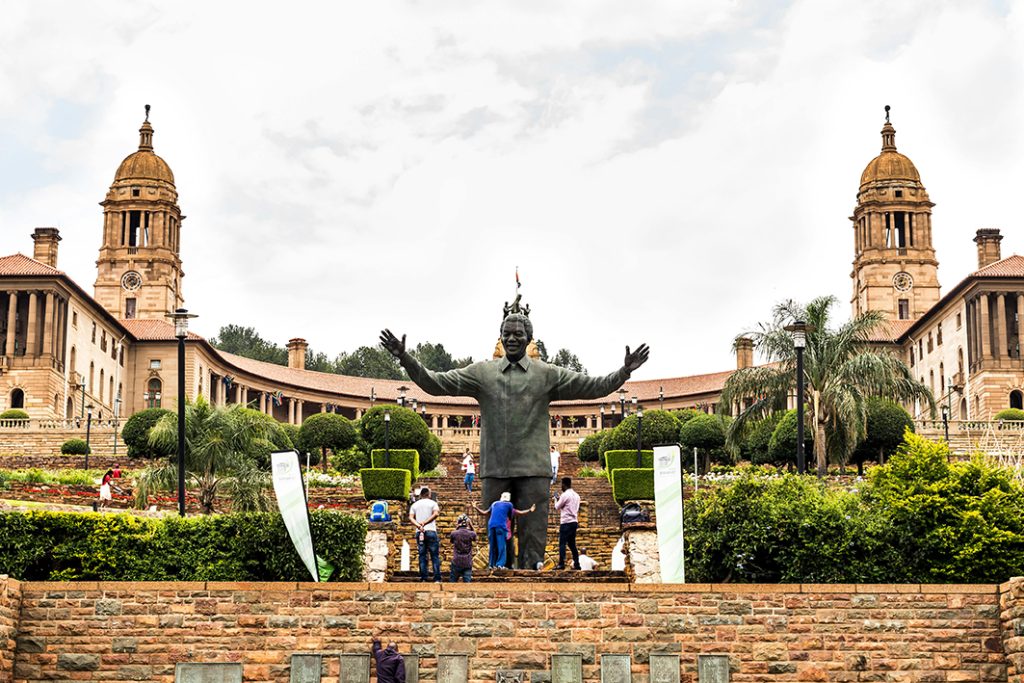
A cost-conscious Smith decided against a huge swearing-in ceremony. Instead, he had Chief Justice Ntokozo Mjwara swear him in as the country’s seventh democratically elected president at the Union Buildings, with the event televised live in the country. Some of Democratic South Africa’s fervent supporters watched the swearing-in on a big screen at the Union Buildings lawn.
President Smith was not unmindful of the political significance of his election to the highest political office in the land. He acknowledged that fact during his inaugural address to the nation after he was sworn in:
Compatriots, today we have turned a major psychological corner as a country. We have shown that ours is, indeed, a country with endless possibilities, where the best among us are placed in positions of trust to advance this Republic’s best interests.
I know that there are some among our compatriots who are very unhappy with my election as President. They argue not only that it reminds them of our ugly past before the dawn of our democracy, but that I am inclined to be the President of a white South Africa. I would like to assure those sceptics that I am definitely not the President of my party, Democratic South Africa, or even of white South Africa. Instead, I am the President of all South Africans in their diversity.
As President, I will fight for the poor of Malamulele in Limpopo and Qunu in the Eastern Cape, just as much as I will fight for the wealthy of Stellenbosch and Sandton. I will fight for the factory and farm workers just as much as I will fight for our captains of industry, and I will fight for our trade unions just as much as I will do so for the business community.
I fully intend to be the President of all South Africans. In the coalition government that I have the privilege to lead, we will fight tooth and nail to ensure that all South Africans have a better life. From today onwards, I assure South Africans that only the best and the brightest will be appointed Directors-General of Government departments and Non-Executive Directors of our State-owned enterprises. From today onwards, cadre deployment will be a thing of the past.
I ask all of you, including those who were not happy with my election, to give me and my government a chance. If we fail to do only the very best for our country, I encourage our MPs to pass a vote of no-confidence in me so that the Government will be dissolved and formed anew. That is my pledge to all of you.
In the remaining four years of this coalition government, we will do everything possible to turn South Africa into a preferred investment destination and ensure that our high unemployment rate is halved. As a country, we will seek to live within our means: there will be no further borrowings from the international financial markets to pay salaries, and there will be no tax increases on my watch. To balance our books, we will critically examine everything on which we spend your tax money and ensure that we are circumspect in its use. Going forward, for instance, we will conduct a thorough assessment of the civil service and reduce it accordingly.
To our labour partners, we know that our employees in the civil service are the heart of government. However, this government will not again approve salary increases above the inflation rate. While we will honour all currently existing agreements, in future my government will approve only inflation-related salary adjustments.
My compatriots, the Government that I have the responsibility to lead will lead by example. Not only will I reduce the size of the Cabinet to 20, representing the four parties in the coalition, but there will be no more than six Deputy Ministers. More importantly, with immediate effect, the salaries of all members of the Government – that is our Cabinet Ministers, the Deputy President and myself – will be reduced by 10%.
I would also like the other arms of our government to consider ways in which they can take similar actions. I stress, however, that we will need the best MPs in our Parliament, who will always be alert and hold us to account as the Executive, and we want to continue to attract only the very best to the judiciary, including the magistracy.
I know I have made a lot of promises here today. I encourage you, my compatriots, to judge me not by what I say, but by what my Government and I do. This is a brave new opportunity for our beloved country. We dare not squander it.
Thank you. God bless South Africa. Nkosi sikelela i-South Africa. Modimo boloka Sechaba sahesu.
For those above the age of 50, President Smith’s speech had echoes of Nelson Mandela’s inaugural address on May 10 1994, when he stated: “Never, never and never again shall it be that this beautiful land will again experience the oppression of one by another”. It was replayed on television throughout the day and reported upon in hourly news bulletins on the radio. The following day, all the newspapers led with the speech, with a picture of a smiling President Smith on their front pages. It was also shown on international networks like CNN, Sky News, Aljazeera and the BBC World Service throughout the day and carried prominently—on the front pages—of major international newspapers. Yet again, there was hope for South Africa.
The speech was discussed in shebeens and taverns, on buses, aboard taxis, at schools and universities, on factory floors and in various offices. Bar a small minority, most people agreed that President Smith had delivered a speech that spoke to all South Africans. What remained to be seen was whether his Government would, indeed, deliver on his promises. After all, people said, the proof of the pudding is in the eating. The next four years were going to be very long.
Dr Kaizer Nyatsumba is a Business Rescue Practitioner, Turnaround Strategy Expert, Strategy Sessions Facilitator and Managing Director at KMN Consulting